At Campion College, history is not studied in isolation.
Through our Bachelor of Arts in the Liberal Arts, students explore ancient, medieval, and modern history alongside the literature, philosophy, theology, and cultural movements that shaped each historical period.
Rather than studying historical events alone, students encounter the ideas, beliefs, and intellectual traditions that influenced how societies understood the world in their own time.
This integrated approach gives students a deeper understanding of Western civilisation and develops the analytical, communication, and critical thinking skills that form the foundation for future study and professional life.
Explore the liberal arts degree
Apply Now
More than a history degree
Many history degrees focus primarily on events, dates, and political developments. At Campion College, students study history within its wider intellectual and cultural context through an integrated curriculum in history, literature, philosophy, and theology.
This approach has shaped the College from the beginning. Rather than adding a humanities stream onto an existing university structure, Campion College was founded as a liberal arts college where disciplines are intentionally studied together.
 |
Study historical periods alongside the literature, philosophy, and religious ideas that shaped them. |
 |
Subjects are intentionally sequenced to build historical understanding. |
 |
Participate in discussion-based classes led by academics who know their students personally. |
 |
Build a strong foundation before pursuing specialised postgrad study or careers. |
From Antiquity to the Modern World
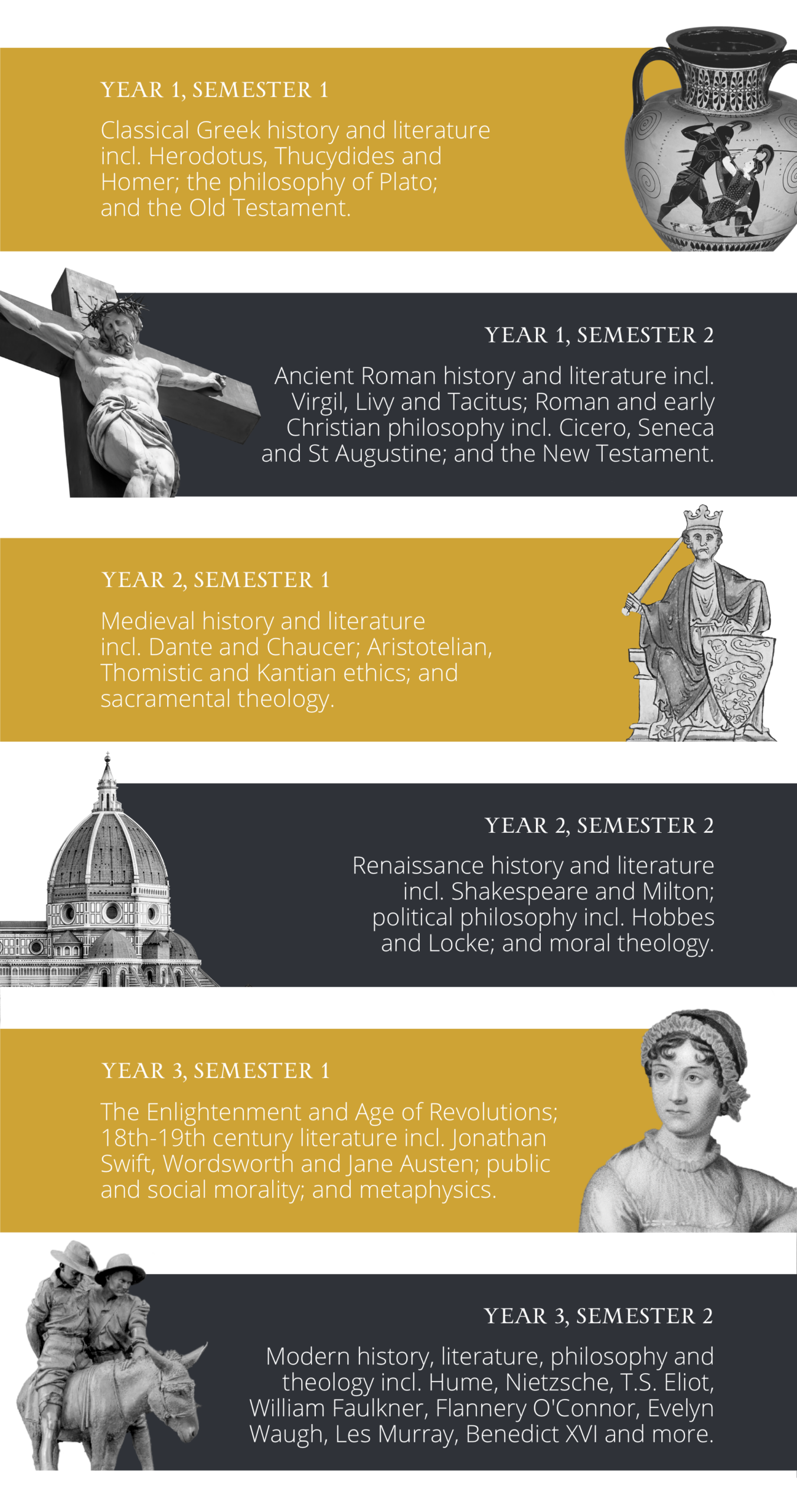
At Campion College, students do not study history as a disconnected sequence of events and dates. Each historical period is explored through its literature, philosophy, theology, and cultural movements, allowing students to understand how people understood the world in their own time.
Students begin in the ancient world, studying Classical Greek history alongside Homer, Herodotus, Thucydides, Plato, and the Old Testament.
The Roman world is explored through historians and literary figures such as Livy, Tacitus, and Virgil, alongside Roman philosophy, early Christian thought, and the writings of St Augustine.
In the medieval period, students encounter Dante and Chaucer while studying Aristotelian philosophy, ethics, sacramental theology, and the development of medieval Europe.
Renaissance and early modern history are studied through Shakespeare and Milton alongside political philosophy including Hobbes and Locke.
The degree culminates in the modern world, where students engage with Enlightenment thought, revolutionary history, modern literature, philosophy, and theology through figures such as Jane Austen, Nietzsche, T.S. Eliot, Evelyn Waugh, Flannery O’Connor, and Benedict XVI.
This integrated approach allows students to experience historical periods not simply as observers of the past, but through the ideas, works, and intellectual traditions that shaped them.

A Community of Learning
• Small seminar-style classes centred on discussion
• Close academic mentorship from full-time lecturers
• Integrated study across history, literature, philosophy, and theology
• A structured curriculum designed intentionally from first year to third year
• Opportunities to major in history or combine history with another discipline in later years
• A learning environment focused on intellectual formation and community
|
Where Can a History Degree Lead?
Campion College’s liberal arts degree provides strong preparation for specialised postgraduate study and diverse professional pathways.
Graduates interested in history frequently pursue further study or careers in areas such as:
• academia and research
• museum and heritage work
• teaching and education
• archival and cultural institutions
• journalism and media
• communications and publishing
• law and public policy
• ministry and theological study
By developing skills in analysis, research, writing, discussion, and critical thinking, students graduate prepared for both professional life and lifelong intellectual engagement.
For students seeking a richer and more immersive way to study history, Campion College offers a distinctive alternative within Australian higher education.
Study the Bachelor of Arts at Campion College
Download Course Guide