

There is something strangely modern about Hamlet.
Unlike many of Shakespeare’s heroes, Hamlet does not rush into action. He overthinks, questions himself, delays decisions, spirals into doubt, performs different versions of himself depending on his audience, and becomes consumed by thoughts he cannot escape. Four hundred years later, he still feels psychologically recognisable.
Part revenge tragedy, part philosophical drama, Hamlet remains filled with some of Shakespeare’s most quoted and unsettling lines — not because they offer easy wisdom, but because they expose uncomfortable truths about grief, mortality, identity, and the difficulty of understanding ourselves.
“To be, or not to be: that is the question.”
Possibly the most famous line in Shakespeare, and perhaps in all of literature.
Yet stripped of cultural familiarity, the quote is surprisingly intimate. Hamlet is not making a grand speech about heroism — he is quietly questioning whether enduring the pain of existence is preferable to escaping it entirely.
The line still feels startling because Shakespeare allows Hamlet to think thoughts most people try not to say aloud.
“There is nothing either good or bad, but thinking makes it so.”
Hamlet says this while speaking to Rosencrantz and Guildenstern, and the line perfectly captures the restless uncertainty of the play.
Nothing in Hamlet feels stable. Motives are hidden, appearances deceive, loyalties shift, and Hamlet himself constantly questions reality, morality, and perception.
The world of the play becomes psychologically slippery.
“Seems, madam? Nay, it is; I know not ‘seems.’”
One of Hamlet’s deepest frustrations is the gap between appearance and reality.
The court of Denmark is filled with performance: polite speeches, false loyalty, public grief, hidden motives. Hamlet despises this artificiality, particularly after his father’s death and his mother’s rapid remarriage.
The line lands so powerfully because Hamlet himself will soon begin performing too.
“I have of late—but wherefore I know not—lost all my mirth.”
Suddenly, Hamlet feels incredibly modern.
The speech that follows is one of Shakespeare’s most haunting descriptions of emotional exhaustion. Hamlet describes the world as empty, joyless, and strangely unreal, despite recognising its beauty intellectually.
It reads less like theatrical melancholy and more like genuine depression.
“The play’s the thing wherein I’ll catch the conscience of the king.”
One of the cleverest moments in the play.
Rather than confronting Claudius directly, Hamlet stages a performance mirroring his father’s murder in order to observe the king’s reaction. Shakespeare turns theatre itself into a weapon — something capable of exposing hidden truth.
It is also wonderfully ironic: in a play obsessed with deception, performance becomes the closest thing to honesty.

“Frailty, thy name is woman!”
Hamlet’s bitterness toward his mother spills out constantly throughout the play.
The line is unfair, emotional, impulsive, and revealing. Hamlet transforms his anger toward Gertrude into a sweeping judgement about women generally, exposing both his grief and his immaturity.
Part of what makes Hamlet fascinating is that Shakespeare never presents him as purely wise or admirable.
“Alas, poor Yorick! I knew him, Horatio.”
One of the most recognisable scenes in Shakespeare.
Holding the skull of the court jester he knew as a child, Hamlet suddenly confronts death not as abstraction, but as physical reality. The moment is strange, darkly funny, and deeply human all at once.
The prince who spent the entire play trapped in thought is finally staring mortality directly in the face.
“There are more things in heaven and earth, Horatio, than are dreamt of in your philosophy.”
One reason Hamlet continues to endure is its refusal to provide certainty.
Ghosts appear, motives remain ambiguous, revenge becomes morally tangled, and reality itself often feels unstable. Again and again, Shakespeare suggests that human understanding is limited.
The line opens the play outward into mystery.
“When sorrows come, they come not single spies, but in battalions.”
Hamlet’s suffering never arrives in isolation.
Death, betrayal, grief, suspicion, revenge, madness, political instability — the disasters of the play accumulate relentlessly. Shakespeare captures the overwhelming feeling of life collapsing all at once.
The metaphor remains powerful because it feels painfully recognisable.
“The rest is silence.”
Hamlet’s final words are remarkably simple.
After all the speeches, questions, performances, doubts, and spiralling thoughts, the play ends quietly. Shakespeare gives no triumphant conclusion, only silence after chaos.
It is one of the most haunting endings in literature.
Explore our Shakespeare Quote Series: Hamlet, Richard III, The Tempest, Twelfth Night, and Much Ado About Nothing.
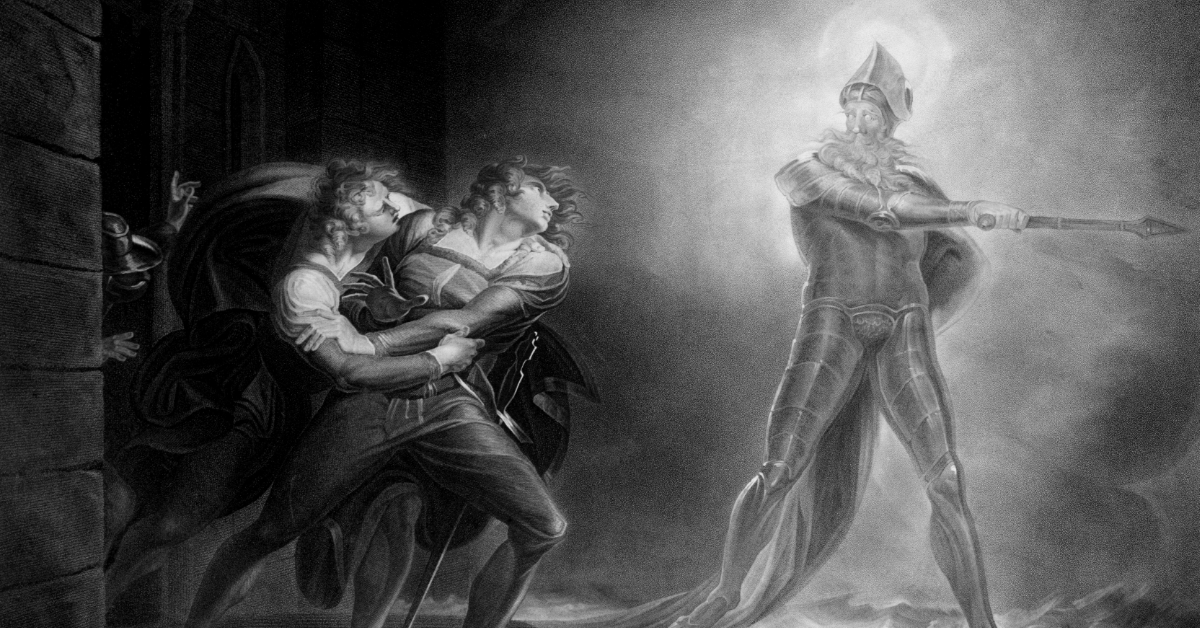
Featured image: Hamlet, Prince of Denmark, Act I, Scene IV by Henry Fuseli. Hamlet, Horatio, Marcellus, and the Ghost, on platform before the Palace of Elsinore.