

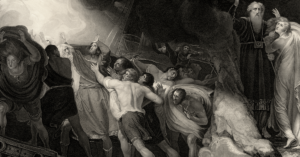
There is something strangely enchanting about The Tempest.
Storms appear from nowhere, spirits sing through the air, characters wander through illusions, and the island itself seems alive with music and mystery. More than almost any other Shakespeare play, The Tempest feels suspended somewhere between theatre, dream, and fairy tale.
Part of its magic comes from its unforgettable characters — each bringing a completely different voice to the island. Prospero speaks like a philosopher-magician, Ariel drifts through songs and riddles, Caliban transforms the landscape into poetry, while even the comic characters seem caught inside the play’s strange enchantment.
Taken together, their lines make The Tempest feel less like a conventional drama and more like a world half-real and half-imagined.
Prospero
“We are such stuff as dreams are made on; and our little life is rounded with a sleep.”
Prospero’s lines often feel less like dialogue and more like spells.
Part ruler, part playwright, and part magician, he shapes the world of the play through illusion, performance, and storytelling.
Ariel
“Full fathom five thy father lies.”
Everything about Ariel feels musical.
The spirit drifts through the play singing strange, haunting songs that blur the line between beauty and unease. Ariel’s language transforms the island into something fluid and dreamlike.
Miranda
“O brave new world, that has such people in’t!”
Miranda sees the world with a sense of wonder untouched by cynicism.
Having grown up isolated on the island, she reacts to new people with amazement and excitement. The line carries innocence, hope, and a touch of irony all at once.
Caliban
“Be not afeard; the isle is full of noises.”
One of the most surprising things about The Tempest is that some of its most beautiful poetry belongs to Caliban.
Often treated as monstrous by the other characters, Caliban speaks about the island with extraordinary sensitivity, transforming it into something enchanted and alive.
Antonio
“What’s past is prologue.”
A single line, yet one of Shakespeare’s most enduring phrases.
Antonio uses it while encouraging Sebastian toward betrayal, suggesting that past events merely set the stage for future ambition.

Stephano and Trinculo
“Misery acquaints a man with strange bedfellows.”
Even amid the magic and philosophy of The Tempest, Shakespeare still finds room for comedy.
Stephano and Trinculo stumble through the island in drunken confusion, forming ridiculous alliances and adding bursts of chaos to the play.
Ferdinand
“The mistress which I serve quickens what’s dead.”
Ferdinand brings sincerity and romance into the strange world of the island.
Compared to the manipulation, ambition, and deception surrounding him, his devotion to Miranda feels unexpectedly gentle and genuine.
Gonzalo
“Had I plantation of this isle…”
Gonzalo imagines building an ideal society on the island, free from wealth, labour, and conflict.
The speech is thoughtful, idealistic, and just slightly impractical — very much in keeping with the dreamlike atmosphere of the play itself.
Sebastian
“A pox o’ your throat, you bawling, blasphemous, incharitable dog!”
Not everyone in The Tempest speaks in poetry and philosophy.
Sebastian’s sharp insults and impatience bring moments of irritation and dark humour that cut through the play’s enchantment.
Prospero’s Farewell
“As you from crimes would pardon’d be, let your indulgence set me free.”
At the end of the play, Prospero steps forward alone.
The magician who controlled storms, spirits, and illusions suddenly asks the audience for release. The moment feels theatrical, personal, and strangely moving — as though the boundary between play and reality has quietly dissolved.
Explore our Shakespeare Quote Series: Hamlet, Richard III, The Tempest, Twelfth Night, and Much Ado About Nothing.
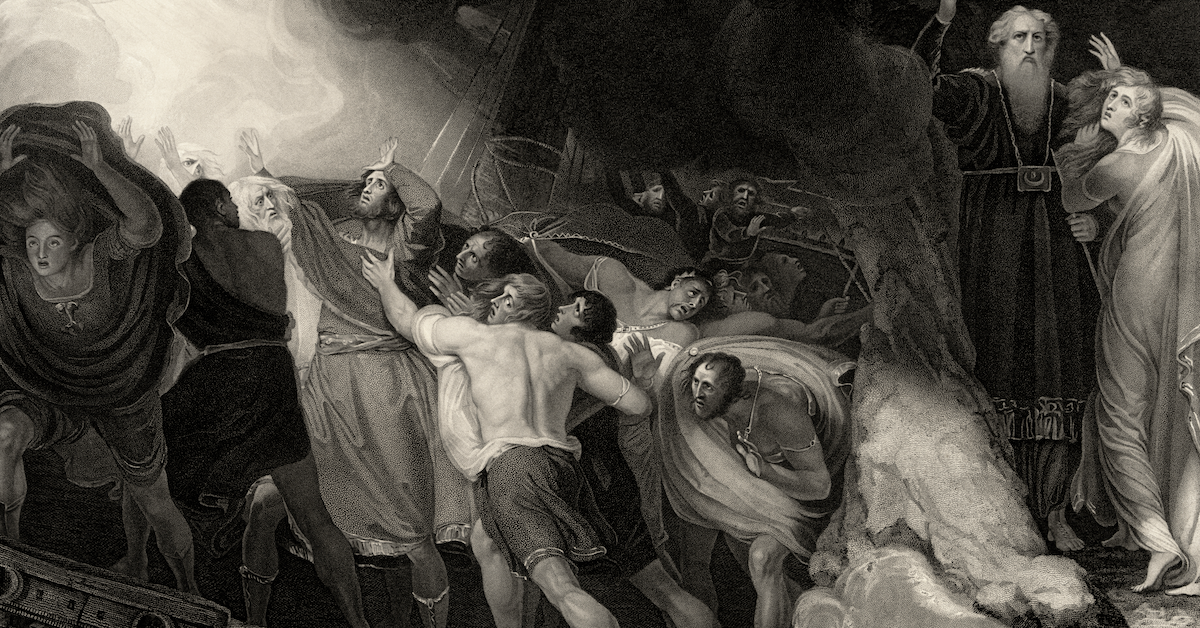
Featured image: Act I, Scene 1 of The Tempest by William Shakespeare, in an engraving by Benjamin Smith based on a painting by George Romney.